
Looking for a job can be exciting… and exhausting.
I’m not an HR expert, a recruiter, or a career coach, just someone who has gone through the job-hunting process multiple times, in different roles, countries, and stages of life.
Sometimes both at the same time. There are days when you feel unstoppable, and others when a single automated rejection email can completely knock the wind out of you. And even though job searching looks like a purely professional process from the outside, the truth is: it’s deeply personal.
I’ve gone through several job searches throughout my career, in different countries, languages, and contexts; and if there’s one thing I’ve learned, it’s that there is no one-size-fits-all formula. But there are ways to approach it with more clarity, strategy, and, most importantly, empathy toward yourself.
In this article, I’m sharing what actually helped me during my own job searches and what didn’t. This is not a definitive guide, but a personal one: practical reflections on job hunting and on using LinkedIn intentionally, especially if you’re a junior professional, a creative, or navigating a career change.
1. Before sending applications: get clear on what you actually want
When I first started looking for jobs as a junior professional, I applied to almost everything that vaguely matched my profile. Later, when I changed roles and even countries, I repeated the same mistake, just with a better CV.
What I learned the hard way is that job searching without clarity is exhausting.
If you’re a junior, a creative, or someone switching careers, this step matters even more. You’re not just looking for a job, you’re trying to understand where you fit and where you want to grow.
Ask yourself:
▸ What kind of role am I really looking for right now?
▸ What skills do I want to develop in the next 1–2 years?
▸ What kind of environment helps me do my best work?
▸ What am I not willing to compromise on?
Clarity doesn’t mean having everything figured out. It simply helps you stop chasing roles that look good on paper but feel wrong in practice.
This sounds obvious, but many job searches become frustrating because we skip this step. Applying to “everything that fits more or less” might feel productive, but it often leads to burnout and disappointment.
Ask yourself:
▸ What kind of role am I really looking for?
▸ What tasks give me energy and which ones drain me?
▸ What am I not willing to compromise on right now?
Clarity doesn’t mean rigidity. It simply helps you make better decisions about where to invest your time and emotional energy.

2. Your CV gets you in the door, your story gets you the job
As a creative and marketing professional, I’ve worked across journalism, content, video, and product-focused roles; often having to explain why my background made sense instead of fitting into a neat box.
That’s when I realized: Your CV alone rarely tells the full story. Your narrative does.
This is especially important if you are:
▸ A junior with limited experience
▸ A creative with a non-linear career
▸ Someone transitioning into tech or a new industry
Instead of listing responsibilities, focus on:
▸ The problems you worked on
▸ The skills you transferred between roles
▸ The impact you had, even in small projects
Hiring managers don’t just hire skills, they hire context and potential.
Your CV should be clear, concise, and adapted to the role you’re applying for. But beyond bullet points and job titles, what truly makes a difference is the story behind your experience.
Recruiters and hiring managers are not only looking for skills, they’re looking for patterns, motivation, and problem-solvers.
When possible:
▸ Tailor your CV to highlight relevant impact, not just responsibilities
▸ Quantify your work whenever you can (numbers matter)
▸ Use concrete examples and outcomes
▸ Make it easy to understand how you think and work
For example, instead of saying:
“Responsible for content strategy”
Try:
“Improved organic traffic by 30% through a content strategy focused on SEO and long-form articles”
You don’t need huge numbers or perfect metrics ; even small, honest improvements show how you approach problems and measure success.
If possible, keep your CV to one page.
Especially for junior profiles, creatives, or career switchers, a clear one-page CV forces you to prioritize what’s truly relevant and makes it easier for recruiters to scan quickly. Clarity almost always beats completeness.
And yes, this takes time; but fewer, more intentional applications often work better than dozens of generic ones.
See here a CV example.
3. LinkedIn is not just a job board (and that’s a good thing)
At one point in my career, I realized that my CV and LinkedIn profile weren’t enough to show how I think and work, especially as a marketing creative.
So I built my own personal website to function as an online portfolio (which is where you are at this very moment).
Not a fancy one. Not perfect. But a place where I could:
▸ Give context to my experience
▸ Show projects beyond job titles
▸ Connect strategy, data, and storytelling in one narrative
Having a personal website helped me feel more grounded during my job search. It gave me ownership over my story instead of trying to fit everything into a standard format.
For creatives, marketers, and career switchers, a simple portfolio site can be incredibly powerful; even if it’s just a few selected projects and a clear “About” page.
LinkedIn then stopped being the place where everything had to live, and became what it’s best at: a place to connect.
When I moved countries and had to rebuild my professional network from scratch, LinkedIn became less of a job board and more of a bridge.
For juniors, creatives, and career switchers — especially in international contexts — LinkedIn can level the playing field if you use it intentionally.
Here’s how to do that:
Optimize your profile for humans, not algorithms
Your headline and “About” section are your chance to tell people who you are now, not just what your last job title was.
A simple structure that works well:
▸ What you do
▸ What you’re good at
▸ What you’re exploring or looking for next
This is also where you can briefly explain career changes or hybrid profiles — instead of letting recruiters guess.
Be visible without trying to be an influencer
You don’t need to post daily or share viral hot takes.
What actually helps:
▸ Sharing learnings from projects or courses
▸ Writing short reflections about your job search or transition
▸ Commenting thoughtfully on posts in your industry
Visibility builds familiarity and familiarity builds trust.
Treat networking as conversation, not self-promotion
Some of the most valuable opportunities I’ve had started with simple, human messages, not long pitches or formal cover letters.
If you’ve applied for a role and want to reach out on LinkedIn, a short and genuine message is more than enough.
Here are a few examples you can adapt:
Example 1: After applying for a role
Hi 🙂 I’ve just applied for the XYZ role. I’m excited about the opportunity to combine strategy, data, and storytelling, and I’d love to connect and tell you a bit more about my background.
Example 2: Reaching out to someone in the team
Hi! I came across your profile while researching the XYZ role. I’m currently exploring similar positions and would love to hear a bit about your experience working in this team.
Example 3: Career switch or junior profile
Hi! I’m transitioning into XYZ and currently building experience through projects and learning. I really enjoyed reading about your path and would love to connect.
The goal isn’t to ask for a job, it’s to start a conversation. Curiosity and clarity go much further than self-promotion.
Some of the most valuable opportunities I’ve had started with simple, human conversations.
Instead of asking for a job:
▸ Ask how someone transitioned into their role
▸ Ask what skills matter most in their team
▸ Ask for perspective, not favors
People remember curiosity more than perfect pitches.
Many people treat LinkedIn like a passive job portal: apply, wait, repeat. But its real power lies in visibility and connection.
Here’s how to use it more strategically:
Optimize your profile
Your headline and “About” section matter more than you think. They should clearly answer:
▸ What do you do?
▸ What value do you bring?
▸ What are you interested in next?
You don’t need buzzwords, you need clarity.
Be visible, even if it feels uncomfortable
You don’t have to post every day or become a “personal brand.” Simple actions help:
▸ Share articles or insights related to your field
▸ Comment thoughtfully on posts you genuinely find interesting
▸ Update your profile when you’re open to new opportunities
This keeps you on people’s radar without forcing anything.
Use networking as conversation, not transaction
Reaching out doesn’t mean asking for a job. It can be as simple as:
▸ Asking about someone’s role or career path
▸ Commenting on a project they shared
▸ Reconnecting with former colleagues
Most opportunities come through conversations, not applications.
4. Rejection is not a verdict on your value
This might be the hardest part. Job searching comes with rejection — sometimes a lot of it — and it’s easy to internalize it.
Something I learned the hard way: not every rejection (or silence) is real feedback.
In more than one case, I found a role on LinkedIn, applied through the platform… and later discovered that the HR team had never received my application. LinkedIn bugs, broken integrations, or internal systems can fail — and it happens more often than we think.
My personal rule now:
▸ Use LinkedIn to discover roles
▸ Whenever possible, apply directly through the company’s website
It reduces friction, ensures your CV actually arrives, and sometimes even gives you more context about the company and the role.
A rejection usually means:
▸ Timing wasn’t right
▸ The role changed
▸ Another profile fit a very specific need
▸ Or your application simply never made it to a human
It rarely means you’re “not good enough.” Try to separate feedback (when you get it) from self-worth.
5. Pace yourself — this is a marathon, not a sprint
Job hunting is mentally demanding. It’s easy to treat every application as a mini verdict on your career, but that mindset is exhausting and unsustainable.
What helped me was treating the job search like a project, not a judgment.
One of the most underrated tips I can share: track your applications.
When you’re applying to many roles, it’s surprisingly easy to forget:
▸ Which companies you applied to
▸ Which role it was exactly
▸ When you applied
▸ Where you applied through
▸ Or whether you ever followed up
I keep a very simple spreadsheet (nothing fancy) where I track:
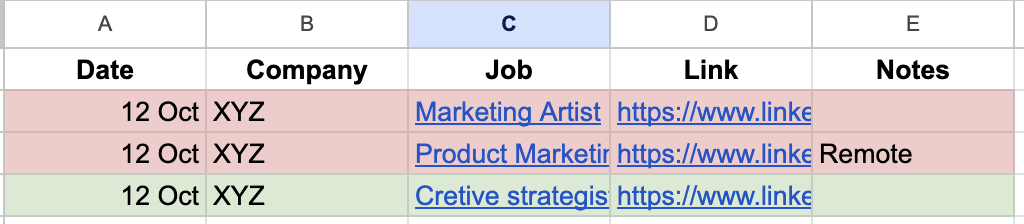
This small habit reduced my mental load a lot. It helped me feel more organized, remember what I had applied for before interviews, and follow up more intentionally.
Most importantly, it created some emotional distance: instead of “Did they reject me?” the question became “What’s the status of this application?”
Set boundaries:
▸ Dedicated time blocks for applications
▸ Time away from LinkedIn
▸ Space for rest and perspective
Progress isn’t always visible, but consistency matters.
Final thoughts
If you’re a junior professional, a creative, or someone navigating a career change — especially across countries or industries — job searching can feel overwhelming.
I’ve been there. More than once.
The process is rarely linear, and platforms like LinkedIn won’t magically fix everything. But used with intention, they can help you be seen, understood, and connected.
For SEO purposes, remember this: recruiters don’t just search for keywords — they search for people who make sense.
Tell your story clearly. Show up consistently. And be patient with yourself.
You’re not behind, you’re building.
Don’t miss more articles like this one on the blog.
