

A behind-the-scenes look at how PMM work actually happens.
If you Google “What does a Product Marketing Manager do?”
you’ll probably find something like:
▸ Writes messaging
▸ Supports Sales
▸ Launches products
▸ Creates decks
All true.
Also… wildly incomplete.
Because real Product Marketing doesn’t start with slides.
It starts with confusion.

▸ Confusion in the market.
▸ Confusion inside the company.
▸ Confusion about value.
And the PMM’s job is to turn that into clarity.
Recently, while working on a strategic PMM case for an enterprise SaaS company, I found myself doing what PMMs do best: connecting dots across product, sales, marketing, and customer reality. This article is a peek into that process, how PMM work actually looks when you zoom in.
1. PMM starts before the product story
A common mistake is to jump straight into features.
A PMM slows things down and asks uncomfortable questions first:
▸ What problem are we really trying to solve?
▸ Where is value leaking today?
▸ What do customers think the product is, vs what we want it to be?
▸ What behavior needs to change internally?
In my case, the product wasn’t the problem.
The company already had strong technology and trusted customers.
The real issue?
Value wasn’t being captured consistently.
That’s a Product Marketing problem.
2. Working with imperfect information (and owning your assumptions)
PMMs rarely have perfect data.
What we do have is fragments:
▸ Sales feedback (“Customers say it’s too expensive”)
▸ Customer behavior (“They stop engaging after X”)
▸ Product reality (“This is powerful but hard to explain”)
Instead of pretending we know everything, I work with explicit assumptions.
Example: Assumptions slide (template)

This is powerful because:
▸ It shows structured thinking
▸ It invites collaboration
▸ It reduces political tension
PMM is not about being right.
It’s about being useful, directional, and strategic.
3. Value proposition is not a sentence — it’s a system
If PMM had a heart, this would be it.
A value proposition is not:
“Automate X with Y using Z.”
A value proposition is:
“Because you struggle with this, we help you achieve that, so your business can win here.”
How I usually structure value (example framework)
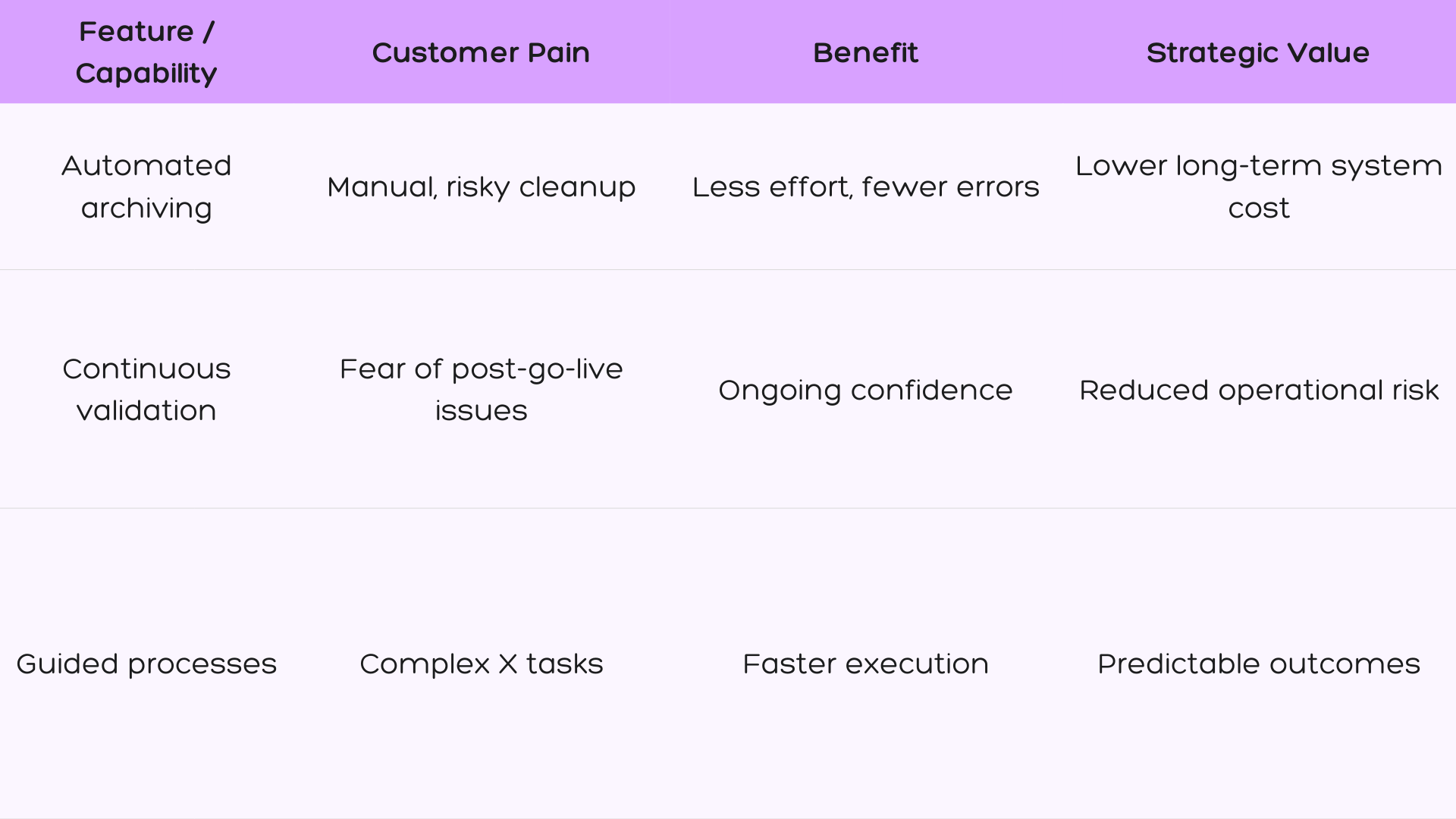
Once this is clear, everything else becomes easier:
▸ Website messaging
▸ Sales narratives
▸ Launch strategy
▸ Enablement materials
If the value proposition is weak, no campaign will save it.
4. PMM is orchestration, not ownership
Another myth: PMMs “own everything”.
Reality: PMMs orchestrate.
In practice, that means:
▸ With Product → aligning on problems, not just features
▸ With Sales → enabling conversations, not just decks
▸ With Marketing → turning strategy into demand
▸ With Customer teams → closing the feedback loop
In my daily work, this often looks like:
▸ Bundling products instead of selling features
▸ Bi-weekly sprints with Marketing
▸ Clear RACI models to avoid chaos
▸ One shared narrative across teams
A good PMM reduces friction.
A great PMM changes behavior.
5. Launches are not moments — they’re processes
Especially in B2B and enterprise, launches fail for one reason:
Sales isn’t ready.
My launch philosophy:
-
Align internally first
-
Enable customer-facing teams
-
Test messaging with a safe audience
-
Launch externally
-
Measure → learn → iterate
If internal clarity is missing, external messaging won’t land.
6. Measuring success without drowning in numbers
I’m not obsessed with vanity metrics, but I care deeply about meaningful ones.
The metrics I look at most:
▸ Adoption / attach rate
▸ Sales velocity & deal clarity
▸ Retention and long-term relevance
The question behind every metric:
Is our messaging changing behavior?
If yes, PMM is working.
7. The human side of Product Marketing
This part doesn’t show up in job descriptions.
PMM work means:
▸ Managing change fatigue
▸ Translating between very different minds
▸ Saying “no” diplomatically
▸ Turning complexity into calm
What motivates me most is simple:
When Sales says, “This helped close a deal.”
Or when a customer says, “Now I finally understand your product.”
That moment — when clarity replaces confusion — is the reward.
Final thought
Product Marketing is not about being the loudest voice.
It’s about:
▸ Listening deeply
▸ Thinking structurally
▸ Communicating clearly
▸ And aligning people around value
That’s the work.
That’s the craft.
And that’s why I love being a PMM.
Don’t miss more articles like this one on the blog.
